Passing Through the World - ALWAYS ON THE WAY
At last, I set foot in Dunhuang.
Press play on the playlist — let the journey begin.
Dunhuang — a name that has tugged at the human heart for centuries. Caves swallowed by sand and wind, murals painted by time itself, and the faint echoes of civilizations buried deep in history.
The Book of Later Han called Dunhuang "the great meeting place of Chinese and foreign peoples" — the brightest pearl strung along the Hexi Corridor, the place where Zhang Qian first turned his face west.
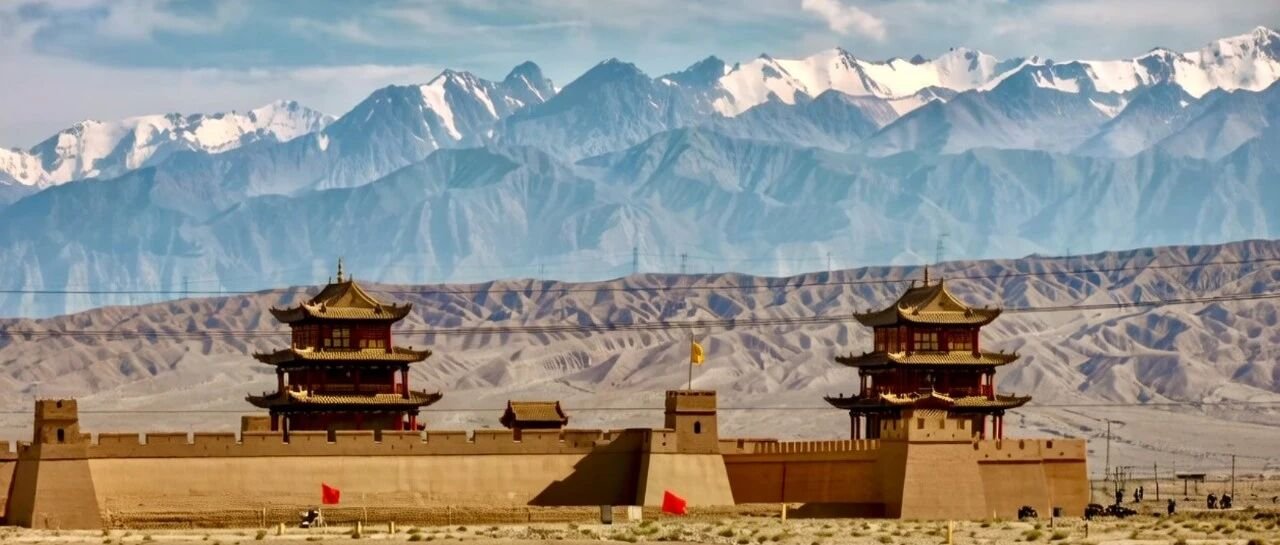
We came in the off-season, and that made all the difference. The tour groups had melted away, leaving us free to drift among the Mogao Caves, Yulin Grottoes, and Western Thousand Buddha Caves, alone with the murals and unhurried. Only the light crept slowly across a thousand years of brushstrokes. At Yangguan and Yumen Passes — where the old poem warns that "going west, you'll find no old friends" — you can almost feel the weight of that history settle on your shoulders.
That, to me, is the ideal way to travel.
We boarded the Z259 in Xining and slept through the night, waking to a landscape utterly transformed — an endless expanse of Gobi. At 9:10 AM the train pulled into Dunhuang Station, right on schedule.
The station was tiny, the sunlight almost violent, the air thin, cold, and bone-dry. A taxi took us in, the driver cheerful as he heaved our bags inside, and before long we were at the hotel. Check-in was still two hours off, yet the gentle clerk at the front desk arranged an early room without a second thought — a small, welcome kindness.
After a short rest and a quick lunch, we set out straight for Leiyin Temple and Mingsha Mountain Crescent Lake.
01 - Leiyin Temple
Leiyin Temple is just 1 kilometer from Mingsha Mountain Crescent Lake.
This isn't the fictional Leiyin Temple of Journey to the West, nor is it some crumbling antiquity. But meet the temple cat, and you'll leave feeling the trip was worth it.
Legend says the ancient Leiyin Temple was near Crescent Lake but was buried by sand. Rebuilt in 1989, its architectural structure is said to draw from the Tang Dynasty style depicted in the murals of Mogao Cave 172, giving it a sense of grandeur and serenity.
Leiyin Temple was wrapped in a deep, almost startling quiet. Across the sprawling grounds, only five or six worshippers moved like shadows.
Walking toward the innermost court, a meow drifted out from behind a clump of dry shrubs — a cat! We meowed back; after a few seconds of locked eye contact, it crept toward us, inch by inch, then flopped onto its back and began charming everyone in sight. As we finally headed for the gate, it trailed us all the way out from the temple's depths.
Tickets: Free admission.
02 - Mingsha Mountain & Crescent Lake
Walking toward the scenic area entrance, many of the photo studios on both sides were closed in the off-season, with only a few open. I'd promised Thea a photo shoot, so we randomly picked one called 'Guanquan Tingsha' (Watching the Spring, Listening to the Sand). For 299 RMB including makeup and shooting, we asked for a non-influencer look. Soon, a beautiful flying-apsara maiden was born.
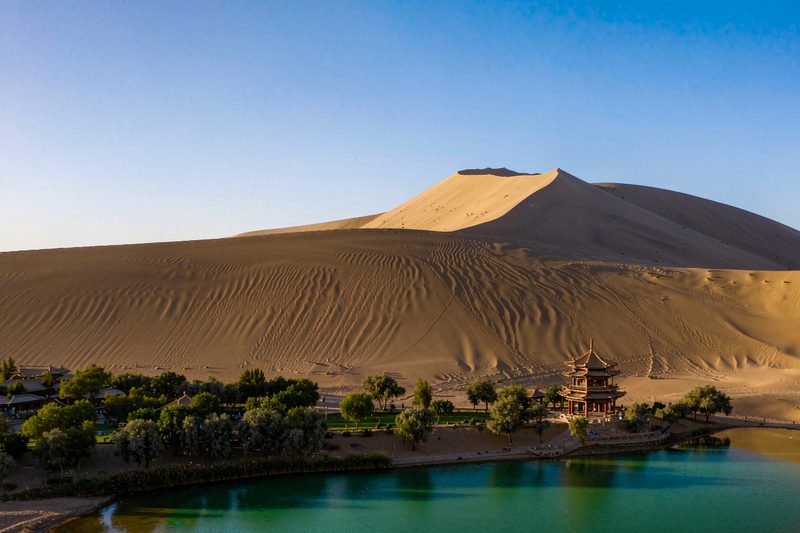
By 3 PM we reached the foot of Mingsha Mountain. The dunes curved in long, liquid lines that made you marvel at nature's hand. The light was kind — soft enough to bare your skin for the camera. After the shoot we climbed onto camels that, having "started work" at age six, strode along briskly, as if eager to clock off for the day — utterly charming.
Climbing the wooden stairs to the dune top looks short, but everyone arrived puffing.
Halfway up, I turned. Crescent Lake lay cradled in the dunes' arms — small, still, skinned over with ice, like a moonstone set in sand. They say this spring has survived thousands of years without once being swallowed by the drifting dunes.
At the summit the wind ran strong and the view opened wide. Far off, a figure picked along the ridge toward an even taller dune. Sitting there, I let the wind rake across the sand — and that faint, ringing note was the sound of distant camel bells.
Tickets: If riding camels, buy a combo ticket — off-season adult 188 RMB, includes sand-proof shoe covers and shuttle bus. Child ticket 27.5 RMB. Important: if you buy the combo ticket, don't buy shoe covers from street vendors, and don't buy cheap sandboards — they're completely unusable.
03 - Mogao Caves
From the 16 Kingdoms period through the Yuan Dynasty, ten successive dynasties spent over 1,000 years excavating caves in Dunhuang, leaving behind 492 caves, 45,000+ square meters of murals, and 2,000+ painted sculptures. This is not just a site — it's a living history of Chinese art spanning a millennium.
I'd dreamed of visiting the Mogao Caves for years. I read Mr. Chang Shuhong's 'The Art of Dunhuang Mogao Caves,' Mr. Fan Jinshi's autobiography 'Deep in My Heart is Dunhuang,' and Mr. Zhao Shengliang's 'A Brief History of Dunhuang Cave Art,' hoping that when I stood inside the caves, I could appreciate this millennium of Chinese art.
Even in the off-season when tickets aren't tight, I still booked in advance. After all, this was the most important day of our Hexi Corridor journey.
In the morning, we took a taxi to the Mogao Caves Digital Exhibition Center (the only entrance for visiting the caves). After collecting tickets, we watched two digital films: 'Millennium Mogao' and 'Dream Buddha Palace.' Then we took the shuttle bus to the cave area. At the entrance, guides formed groups on the spot, distributed earphones, and led us through the caves.
Mogao Cave 285, Northern Wei (replica) — Ceiling celestial map, photographed at the Mogao Caves Conservation Research Exhibition Center.
Mogao Cave 217, High Tang (replica) — Caisson ceiling, photographed at the Exhibition Center.
Mogao Cave 217, High Tang (replica) — 'Contemplation of Infinite Life Sutra Transformation,' photographed at the Exhibition Center.
Mogao Cave 3, Yuan Dynasty (replica) — 'Thousand-Handed, Thousand-Eyed Avalokitesvara,' photographed at the Exhibition Center.
You needn't arrive armed with scholarship — the official guides' commentary is more than enough for the ordinary visitor. The real secret is simply to stand inside the cave, listen, look, and feel. Only then does the old line "one glance at Dunhuang, a dream of a thousand years" finally land.
Don't grieve over missing the real Cave 285 — its essence still comes through in the digital films and the replica caves at the Exhibition Center. As the cool light slides across murals from the Northern Wei, Sui, Tang, Song, Western Xia, and Yuan, wonder gives way to something quieter: a fretful worry for the survival of art a thousand years in the making.
Go early — don't be the one left regretting it when the gates close.
Tickets: Off-season adult 140 RMB (December 1 to March 31). Ages 6-18 and seniors 60-69: 95 RMB. Book in advance through the official Mogao Caves reservation system.
04 - Encore Dunhuang Show
Next to the Digital Exhibition Center are two famous large-scale performances: 'Encore Dunhuang' and 'Music Moves Dunhuang.' After the caves closed, we found a small restaurant nearby for dinner, then went to the 7:30 PM performance of 'Encore Dunhuang.'
The format broke every rule — for two-thirds of the show the audience walks with the shifting scenes, only settling into seats for the final twenty minutes. A genuinely singular evening.
The show runs four acts and an epilogue. Act 1 introduces the cast; Act 2 stages the 1907 deal struck between Stein and Wang Yuanlu, threading in a cross-time dialogue where modern researchers confront the Taoist priest. When Wang Yuanlu sank to his knees before the bodhisattva, I wept, and found myself beginning to forgive him.
For anyone who has fallen hard for Dunhuang's history, the performance can feel close to transcendent.
Tickets: Off-season is cheaper. About 168 RMB for adults. Children under 1.4m enter free.
05 - Western Thousand Buddha Caves
This is the first stop on Dunhuang's western one-day tour.
Piercing wind, azure sky. This 'sister cave' of the Mogao Caves sits on the cliffs north of the Dang River. It has 22 caves with murals and sculptures, 34 painted sculptures, and over 800 square meters of murals, spanning from the Northern Wei to the Yuan Dynasty.
Tickets: Off-season adult 30 RMB, discount 15 RMB.
06 - Yangguan Pass Ruins
'Going west from Yangguan, you'll find no old friends.' A single poem by Wang Wei captures the unique essence of Yangguan.
Visiting Yangguan, you realize this poem isn't about parting — it's about the boundary of civilization. Founded during the Western Han Dynasty, Yangguan was named for being south of Yumen Pass. Together with Yumen Pass, they guarded the throat of the Silk Road like two iron locks.
Yangguan meant far more than hellos and goodbyes — above all it was a military gate. Those beacon towers, raised every five li, survive now only as mounds of rammed earth.
Through the Han and Tang, anyone heading west had to secure a travel permit at Yangguan — an ancient passport, in effect. I'd strongly suggest buying children a replica pass so they can live the old formalities; the delightful part is that, pass in hand, the "guards" wave you straight through without a second glance!
Tickets: Off-season adult + shuttle 70 RMB, half-price 25 RMB.
07 - Yumen Pass
After lunch we drove on to Yumen Pass. The weather turned on a dime — wind and sand flew so thick they seemed to flay the skin. The world went the color of dried mustard, grit stinging our cheeks. Only then did I truly grasp "the spring wind never crosses Yumen Pass." This was no poet's flourish. It was simply the truth.
Yumen Pass, commonly called Small Square Plate City, sits on the Gobi desert northwest of Dunhuang. Facing Yangguan to the southwest, they jointly guarded the Silk Road's throat.
Remnants of the Han Dynasty Great Wall are still visible, standing resilient in the Gobi after a thousand years of wind erosion. We took a shuttle bus to Hecang City (Large Square Plate City) — an important military supply warehouse for the Great Wall defense from the Han to Western Jin dynasties.
Standing at Yumen Pass today, the Gobi rolls out without end and the old Shule River has long since run dry. Wind and sand are simply this land's daily weather. The Han raised walls here, the Tang set passes, and soldier after soldier stood this gate. A thousand years on, the wind and sand have not stopped. To stand where they stood, brushed by the same gusts, was finally to understand the pass.
Tickets: Off-season adult 20 RMB + shuttle 50 RMB, half-price 10 RMB.
08 - Yadan Geological Park
We left Yumen Pass and pressed west. The car bucked along the Gobi highway for nearly 100 kilometers, the wind rising to a fury that showed us the raw muscle of the great Northwest.
Yadan National Geological Park holds the world's largest and most fully formed Yadan landscape. We rode the shuttle bus through formations of every shape; up north they stand in majestic ranks, all facing one way, like a "West Sea Fleet" mustered for battle.
Yet Yadan is at its most mesmerizing exactly when the wind lifts — as if the gale itself had taken on a body.
We waited in the wind for the sunset, and at last the sun dropped behind the Yadan ridges like a fallen egg yolk, laying bare a desolation too vast to hold.
Back in the car our driver had hot milk tea and bread waiting — a small, touching thing. The 158-kilometer drive back to Dunhuang deepened into night, the Gobi on either side a wall of black. Suddenly the driver pulled over, stepped out, and tipped his face upward — the sky was stuffed with stars, close enough to scoop up in a handful. It was the most staggering night sky I have ever seen.
Tickets: Winter-spring full price 95 RMB, half-price 82 RMB. Special experiences: shuttle bus and desert dune buggy require separate purchase.
09 - Han-Tang Ancient Road
On Dunhuang's eastern day-trip, the first stop is the Han-Tang Ancient Road — the eastern route's soul, after the Yulin Grottoes themselves. The road twists through black Gobi and low mountain gorges, bare of a single blade of grass, until about an hour's drive delivers you to the Yulin Grottoes.
Not a scenic area. No tickets required.
10 - Yulin Grottoes
Beyond the Mogao Caves, no Dunhuang visit is complete without the Yulin Grottoes — above all Cave 25, crowned "the finest of Dunhuang's cave art." Tucked in a canyon south of Guazhou County, the Yulin River runs through it and the caves are cut into the cliffs along both banks, ringed by elm woods.
The existing caves date from the Tang through the Yuan Dynasty. Their style, content, and characteristics are essentially the same as the Mogao Caves, belonging to the same Dunhuang art system — often called the Mogao Caves' 'sister caves.'
In a sense the Yulin murals complete the art of the Mogao Caves. Cave 25, from the Middle Tang, matters most — a masterwork of Tang mural painting. Its north-wall "Maitreya Sutra Transformation" and south-wall "Contemplation of Infinite Life Sutra Transformation" show the line-drawing grace handed down from Wu Daozi's school.
The Yulin Grottoes keep four special caves — 2, 3, 4, and 25 — with the first special-cave tour leaving at 11 AM. The guide we drew was superb; seeing those special caves is well worth the effort.
Tickets: Off-season adult 40 RMB (includes 5 caves), discount 20 RMB. Transportation: Self-drive or chartered car, off-season cost about 350-400 RMB.
11 - Mud Panel Painting Workshop
As an art lover, how could I visit Dunhuang without trying mud panel painting?
I found a studio on Dianping, and on our last evening in Dunhuang, Thea and I went to paint. First you pick a design — Thea took the Nine-Colored Deer, I chose Manjushri Bodhisattva. The staff printed the pattern, we pinned it to the mud panel with carbon paper, and traced the lines in firm strokes. Tracing looks easy, but it demands focus and a steady hand.
After more than four hours both panels were finished — deeply satisfying. It was the best possible souvenir Dunhuang could give me, or I could give myself.
Cost: 140-198 RMB.
Practical Travel Information
Transportation: Chartered-car services are well established, with fair pricing for both eastern and western routes. For nearby spots like Mingsha Mountain, the Mogao Caves, and the Western Jin Tombs, ride-hailing apps are handy.
Itinerary: Dunhuang deserves at least 4 days. The 7-day Qinghai-Gansu grand loop is not recommended — it doesn't allow enough time to appreciate each destination's essence.
Suggested Itinerary
Day 1: Arrive in Dunhuang, visit Leiyin Temple, Mingsha Mountain & Crescent Lake, photo shoot.
Day 2: Mogao Caves — 10 regular caves + 3 special caves (about 6 hours), watch 'Encore Dunhuang' performance in the evening.
Day 3: Western route — Western Thousand Buddha Caves, Yangguan Pass, Yumen Pass, Yadan Geological Park, sunset, stargazing.
Day 4: Eastern route — Han-Tang Ancient Road, Yulin Grottoes (10 regular + 2 special caves, 2-3 hours), return via 'Son of the Earth' and 'Emperor Wu of Han' sculptures, evening at Dunhuang Night Market, mud panel painting workshop.
Day 5: Continue mud panel painting, afternoon departure to Jiayuguan by high-speed rail.